
Gudrun Valdimarsdottir, PhD, works at the University of Iceland – Department of life sciences.
Her expertise lies in TGFβ signaling, stem cell biology and endothelial cells/angiogenesis. She received her PhD degree on TGFβ signaling in endothelial cells from the Ludwig Institute for Cancer research, BMC, Uppsala University and the Netherlands Cancer Institute, Amsterdam. She was a post-doctoral fellow at the Hubrecht Institute – Molecular and Developmental Biology, Utrecht, the Netherlands, where she studied BMP signaling in mouse and human embryonic stem cells and their differentiation towards beating cardiomyocytes.
2004, PhD, Uppsala University, Sweden.
2004-2005, Post-doctoral fellow at the Hubrecht Institute, Utrecht, the Netherlands.
2006-2010, Postdoctoral fellow at the University of Iceland.
2010-2017, Assistant Professor at the University of Iceland.
2017-present, Associate Professor at the University of Iceland.
Gudrun focuses on mouse and human embryonic stem cell research. These pluripotent stem cells can either self-renew or differentiate into all cell types of the body. The research area is restricted to how certain signal transduction pathways can regulate embryonic stem cell fate, specifically differentiation into cardiomyocytes and endothelial cells.
The lab is interested in cardiovascular development and disease where the focus lies in the endothelium and its interaction with other cell types. It is becoming increasingly evident that blood vessels not only provide oxygen and nutrients to other cells in the body but also have more direct effects. Transforming Growth factor beta (TGF-β) family is known as one of the pivotal growth factors in cardiovascular development and is therefore the common thread running through the two research projects ongoing in the lab:
1) The TGFβ/SMAD pathways in human placental trophoblast invasion and preeclampsia
2) TGFβ-mediated endothelial-tumor interaction in breast cancer
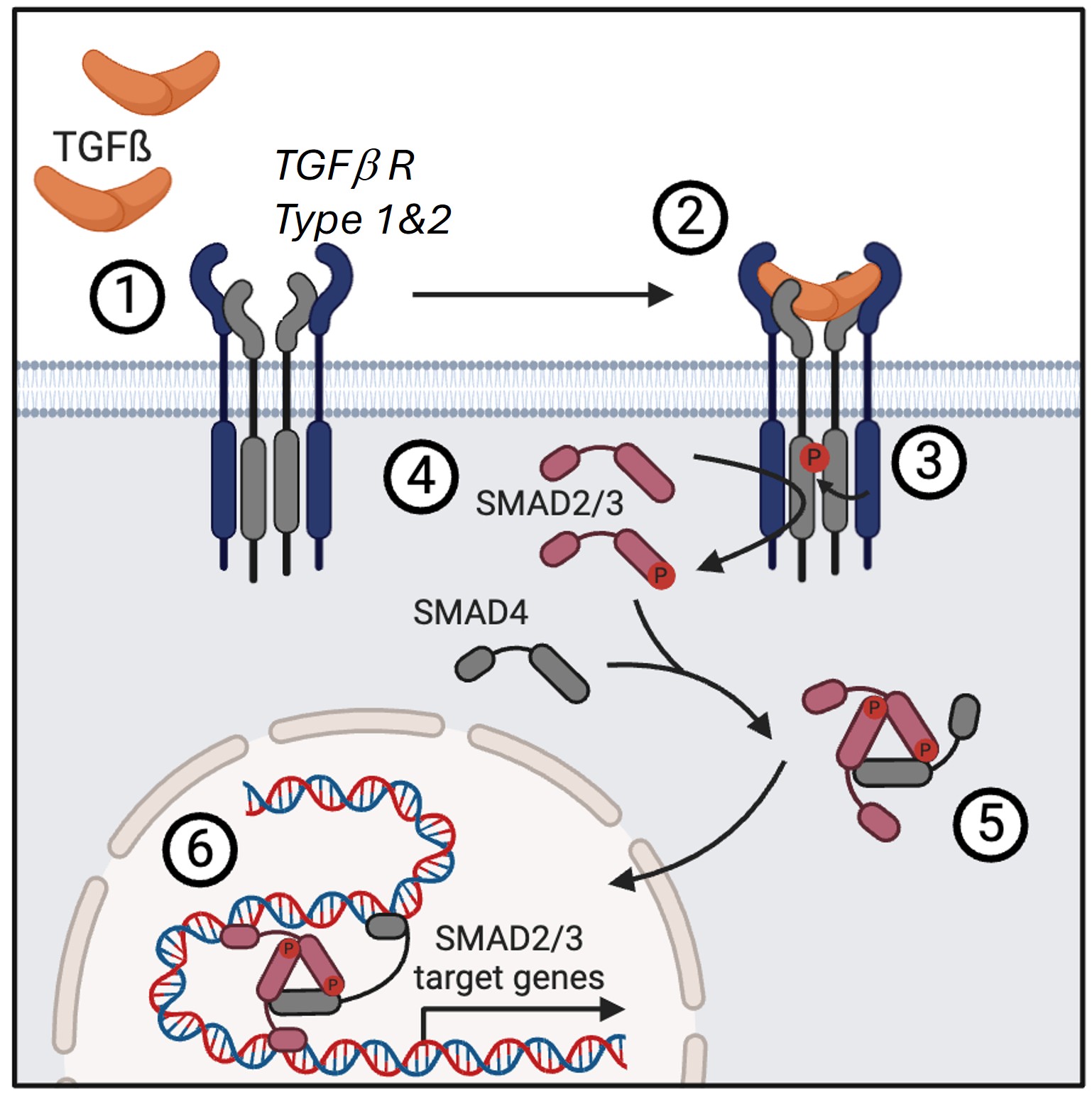
The TGFβ/SMAD pathways in human placental trophoblast invasion and preeclampsia
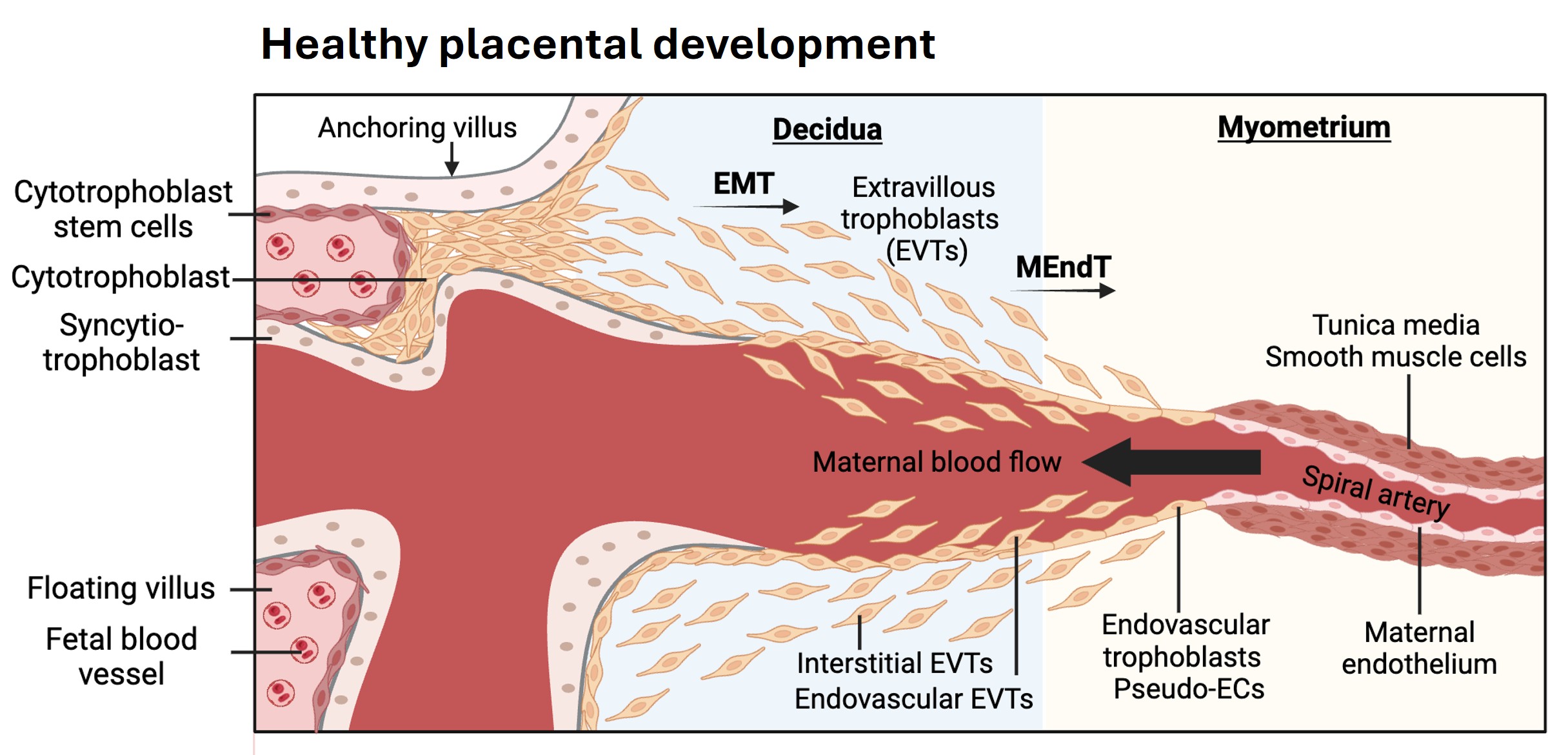
Successful human placental development depends on fetal trophoblasts undergoing sequential epithelial-to-mesenchymal (EMT) and mesenchymal-to-endothelial (MEndT) -like transitions, driving their invasion and subsequent remodeling of maternal spiral arteries for proper placental perfusion. These developmentally programmed processes are disrupted in preeclampsia, a leading cause of maternal and fetal morbidity worldwide. Despite its clinical significance, the molecular mechanisms governing these differentiation trajectories at the fetal-maternal interface remain poorly defined.
We have identified a transient, non-canonical TGFβ signaling axis via dual engagement of the type I receptors ALK5 (TGFBR1) and ALK2 (ACVR1), which activates the transcription factor SMAD1/5 as a critical driver of EMT in human trophoblast (HTR8/SVneo) cells and stem cells. Single-nucleus transcriptomics of first-trimester placentas revealed co-expression of ACVR1, TGFBR1, SMAD1 and SMAD5 at the transition zone between cytotrophoblasts and extravillous trophoblasts, indicating a spatially restricted role of this signaling pathway in early differentiation. Notably, ALK2 and activated SMAD1/5 as well as the EMT marker SNAIL were reduced in preeclamptic placentas. Our results identify a previously unrecognized molecular mechanism in early placental development and indicate that its dysregulation may underlie key pathological features of preeclampsia.
(https://pubmed.ncbi.nlm.nih.gov/32183218/ & https://www.biorxiv.org/content/10.1101/2025.07.21.665880v1).
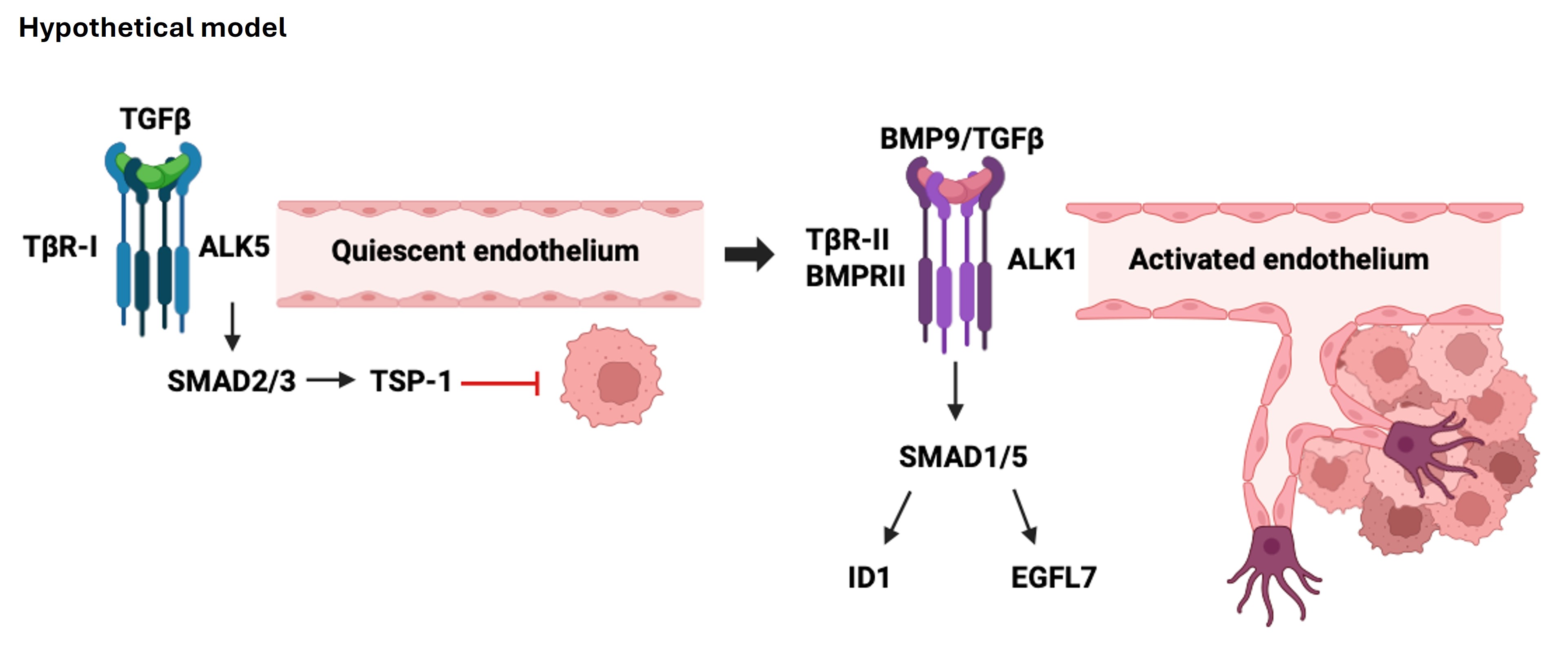
TGFβ-mediated endothelial-tumor interaction in breast cancer
Breast cancer is the most common cancer among women, and mortality is mainly caused by metastasis rather than the primary tumor. Metastasis is the process by which cancer cells leave the primary tumor site, travel to other parts of the body, and form secondary tumors. Some cancer cells can remain dormant for years, evading detection until they metastasize. Metastasis and dormancy are largely influenced by the tumor microenvironment (TME), especially endothelial cells (ECs) and their secreted factors. In ECs, the transforming growth factor (TGFβ) family members BMP9 and TGFβ1 signal through ALK1 and ALK5 receptors, respectively, balancing angiogenic and quiescent endothelial states.
Previous work from our group identified epidermal growth factor-like domain 7 (EGFL7), which has previously been linked to cancer progression, as a BMP9-ALK1-SMAD1/5-dependent mediator of vascular sprouting (https://pubmed.ncbi.nlm.nih.gov/31155507/). Additionally, preliminary data suggest that thrombospondin-1 (TSP-1) is induced downstream of the TGF1-ALK5-SMAD2/3 pathway in a quiescent endothelium, where it may inhibit tumor cell growth.
Current lab members:
Sophia Maria Mähr, PhD student
Vera Amanda Varis, PhD student
Elín Halldóra Erlendsdóttir, medical student (BS project)
Aníta Rut Sigurðardóttir, MS student.
Collaboration:
Dr. Fumiko Itoh, Toyama University, Toyama, Japan
Dr. Petra Knaus, Freie University, Berlin, Germany
Dr. Aristidis Moustakas, Uppsala University, Uppsala, Sweden
Dr. Peter ten Dijke, LUMC, Leiden, the Netherlands.
The TGF/SMAD pathways in human placental trophoblast invasion and preeclampsia
Preeclampsia affects 2-8% of pregnancies and remains the leading cause of maternal and fetal morbidity. The TGFβ signaling pathway has emerged as a critical regulator of trophoblast function, yet its role remains unclear, with conflicting evidence showing both pro- and anti-invasive effects where the classical ALK5/SMAD2/3 pathway has been the main focus. Our recent discovery reveals that TGFβ induces SNAIL expression through a non-classical ALK5/ALK2/SMAD1 pathway in human trophoblast stem cells (hTSCs) - a pathway impaired in preeclampsia. Leveraging recently developed hTSC models and an advanced experimental approach, this project aims to dissect the role of TGFβ/SMAD signaling in trophoblast differentiation and invasion, focusing on extravillous trophoblast (EVT) subpopulations, their interactions at the fetal–maternal interface and how it fails in preeclampsia.
TGF-mediated endothelial-tumor interaction in breast cancer
Our aim is to understand the specific interactions between the vasculature and breast cancer patient-derived tumroids on a TGF-beta basis and to unravel what effect EGFL7 and TSP-1 have on breast cancer progression.
We plan to study the interaction of the vasculature and tumours in two differerent ways:
A. Co-culture of endothelial cells and breast cancer-derived tumoroids in a vascularized tumoroid assay.
B. Molecular interaction betweeen EGFL7, TSP-1 and their receptors and their impact on the breast cancer subtypes, luminal A and triple-negative.
We are always open for talented, energetic people to join the lab. Feel free to contact me at gudrunva@hi.is